
Thinking about knocking down a structure in the Hunter? The right partner makes all the difference. Early in your planning, compare quotes, licensing, and methodology—and give yourself a paper trail that stands up to council and insurer scrutiny. And when it comes to residential demolition in Newcastle, those early decisions often shape the entire project.
Start with approvals, risk, and the Newcastle context
Before price or machinery, confirm how your project will be approved. In Newcastle, small-scale demolition may proceed under a Complying Development Certificate (CDC) if it satisfies the Demolition Code, but many sites still require a Development Application (DA)—particularly where heritage or environmental controls apply. Cross-check your site zoning, overlays, and any heritage conservation areas.
The City of Newcastle provides a demolition information guide detailing typical documents: a demolition plan, Statement of Environmental Effects, evidence of utility abolishment, and asbestos management steps (if relevant). Bookmark it and use it when comparing contractors; a competent contractor will talk to these requirements without prompting.
A quick litmus test: ask each contractor which approval pathway they expect for your address—and why. A confident, compliant operator will reference CDC vs DA rules, Codes SEPP thresholds, and council-specific guidance. If they can’t, that’s a red flag.
Licensing, insurances, and WHS you should sight (not just ask about)
Demolition work is high-risk. You’re entitled to see current copies of:
Demolition licence (and asbestos licence where applicable), plus the licence class that matches the scope.
Public liability insurance with an adequate limit (ask for the certificate of currency).
Workers' compensation cover and evidence of a WHS management system (SWMS templates, incident reporting).
A demolition methodology that aligns with the NSW Demolition Code and addresses dust, vibration, noise, and traffic.
If a home was built before 1987, assume asbestos might be present until proven otherwise—then confirm the contractor’s pathway for testing, removal, and disposal. The City of Newcastle’s guide points to licensed handling and disposal requirements and references WHS laws. You want that process written into the quote and program, not “sorted on the day.”
Scope clarity: what a professional quote will (and won’t) include
A good quote reads like a mini-plan, not a one-liner. Look for:
Inclusions: permits/notifications, services abolishment coordination, temporary fencing, soft strip-out, waste classification, transport and tip fees, backfilling, compaction, and site clean.
Exclusions and assumptions: tree removal, contaminated soil, rock excavation, council bonds, or traffic control.
Evidence: tip dockets and waste tracking, asbestos clearance certificates, and compaction test results—ideally delivered at handover.
Program and sequencing: start/finish dates, critical dependencies (utility abolishment dates), and neighbour notifications.
If you don’t see approval steps referenced, add them. For example, council guidance explains the submission components and pathways; your contractor should mirror that process in their scope.
Permits and notifications: who does what, when
Here’s where homeowners often get tripped up: who actually submits what? Many contractors will manage council documentation and certifier liaison—particularly on CDC projects—yet you remain the legal applicant for some items. NSW’s Planning Portal explains when demolition can be CDC and what standards must be met; use it to sanity-check what your contractor is proposing.
When you hit a Newcastle-specific question—say, bond amounts or asbestos disposal requirements—go straight to the City’s guide. It outlines demolition planning expectations and supporting documents in one place, so you can benchmark contractor advice against official instructions. The Council’s guidance on demolition permits in Newcastle is especially helpful when you’re cross-checking requirements.
For a deeper dive on the rules behind “exempt” or “complying” demolition, the NSW Planning fact sheet is handy when you want the fine print without legalese. Keep it nearby when you’re sense-checking scope or timing.
Price vs value: reading the dollars like a pro
Apples-to-apples comparison is surprisingly rare in demolition. Normalise quotes by extracting the same items:
Waste allowances: what tonnage and class are included? Where is it going?
Services: who’s actually arranging the abolition of electricity, gas, and NBN?
Asbestos contingencies: per-sqm rates and thresholds; is friable material included?
Backfill and compaction: what material, what depth, and will there be a compaction certificate?
A “cheap” quote can balloon if it excludes tip fees, asbestos disposal, or utility abolishment delays. I’ve seen a $6k saving vanish under waste reclassification because the contractor hadn’t priced for bonded asbestos in eaves. If a quote feels thin, it probably is. Cross-check against the NSW Demolition Code and the City of Newcastle’s submission list to see what’s missing.
Machinery, method, and site constraints: ask these on your walk-through
On the pre-quote site meeting, go beyond “we’ll bring an excavator.”
Access: gate widths, overhead lines, tree protection, shared driveways, school zones, and peak-hour restrictions.
Sequencing: soft strip vs structural, utility isolations, scaffold (if deconstruction is needed), and waste staging.
Controls: dust suppression, noise windows, vibration monitoring if you’re near fragile neighbours.
Neighbours: method of fencing, letterbox drops, and contact person during works.
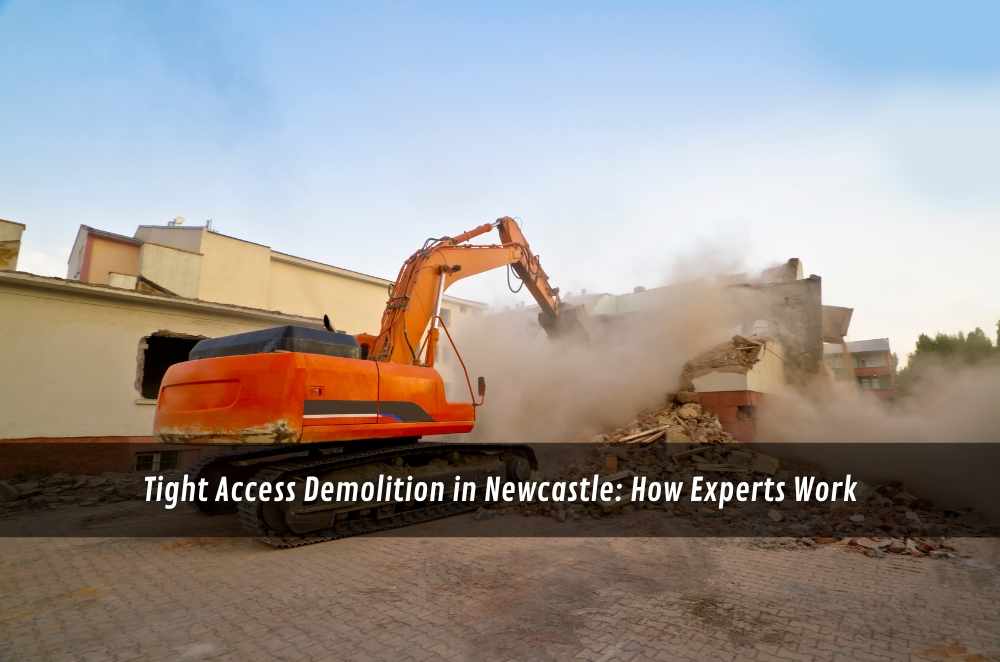
If your block is tight or sloped, raise the idea of mini-excavators, high-reach attachments, or partial hand demolition. You’ll often get a better plan if you signal constraints up front. (I’d also place an internal cross-link later to a detailed logistics piece using tight access demolition Newcastle so readers can dive deeper.)
Responsible waste and sustainability: where does your house go?
Good contractors treat demolition as resource recovery, not just removal:
Salvage of bricks, hardwood, and architectural items.
Clean separation of concrete, steel, and timber for higher-value recycling.
Documented chain-of-custody for asbestos and hazardous waste.
Landfill minimisation targets (ask for a percentage).
Ask for sample tip dockets (redacted). It’s the easiest trust-builder in the game. NSW’s Planning material underscores that compliance and documentation aren’t optional; your end-of-works pack should prove where everything went.
Evaluating communication and culture fit
You’ll spend more time with a demolition contractor than you think. Note:
Do they answer questions with specifics and citations to council or NSW guidance?
Do they send a written program and confirm who is on site each day?
Is there a single point of contact you can reach when something changes?
Are variations pre-priced (e.g., per-tonne waste reclassification rates), not invented mid-job?
Culture shows up in paperwork. If you’re getting tidy emails, dated drawings, and consistent language, you’ll likely get a tidy site.
When to walk away
No licences or out-of-date insurance.
Vague on approvals or tries to “just start” without CDC/DA clarity.
Refuses to name disposal facilities or provide sample dockets.
Quote excludes everything that actually costs money (utilities, asbestos, tip fees, backfill).
There’s plenty of compliant choice in Newcastle. You don’t need to accept risk to get a fair price.
Pulling it all together
Choosing a demolition contractor in Newcastle isn’t about who has the biggest excavator; it’s who can explain your approval pathway, price the true scope, manage risk, and document every step. If you’re dealing with tight access demolition in Newcastle, that clarity matters even more because small sites magnify every mistake. Start with the rules (NSW Planning and the City of Newcastle), build a like-for-like scope, and then pick the team that communicates crisply and proves where your money—and your waste—will go.




Write a comment ...